
If your fresh-water hose froze to the spigot last week, North Central Florida in winter will feel like a different climate. It is not the tropics. Lake City gets frost on a few mornings each winter, and a strong cold front can push the overnight low into the 20s. But most winter days here are dry and sunny, with highs in the 60s. That is warm enough to shut the furnace off, open the windows, and get the rig out of the ice. This post covers what winter weather really looks like in North Central Florida, how to handle a cold snap, and where the area fits in a winter trip.
What winter actually looks like here
The short version: days in the 60s, nights in the 40s. In Detroit, Chicago, Cleveland, or Toronto, the average January high sits right around freezing. Here it runs about 30 degrees warmer.
Winter is also the dry season. Lake City gets about 54 inches of rain a year, and most of it falls in summer afternoon thunderstorms. November and December each average only about 2 to 3 inches. A typical winter week means clear skies, low humidity, and very little time spent waiting out rain under the awning.
Cold snaps happen
North Florida is not South Florida. In January, Tampa averages highs in the low 70s and Fort Myers in the mid-70s. Lake City runs several degrees cooler than both, and the difference shows up most at night.
The pattern is predictable. A few times each winter a strong front comes through. You get a day of wind and clouds, then two or three clear, cold nights with lows in the 30s and sometimes the upper 20s. Then it warms back into the 60s within a few days. The first frost usually arrives in late November, and the last one is usually gone by early March.
That is the trade. You give up a guarantee of shorts weather. In return you get a winter that is mostly mild, a few hundred miles closer to home, with cold spells that last days, not weeks. If you need 75 degrees every day of January, keep driving south. If you just want to get out of the snow, this is far enough.
Cold-snap checklist for your rig
A North Florida freeze is short and mild by northern standards, but it can still split a hose or a fitting. When the forecast calls for a cold night, this is what to do:
Watch the low, not the high. A clear, calm night can drop well below the forecast in open areas. Exposed hoses are at risk once the temperature reaches freezing. Real trouble comes when it stays below about 28°F for several hours.
Deal with the water hose. The simplest fix is to fill your fresh tank before dark, disconnect and drain the hose, and run off your water pump overnight. If you'd rather stay hooked up, use a heated hose rated for drinking water.
Keep the sewer line drained. Close your gray and black valves and dump when the tanks are fuller. A sewer hose with water sitting in a low spot can freeze. Make sure it slopes all the way to the inlet.
Protect the plumbing inside. Open the cabinet doors under the sinks so warm air reaches pipes that run along outside walls. If your rig has tank heaters, turn them on. If your furnace ducts heat to the basement or tank bay, keep the furnace running at a low setting rather than relying only on a space heater.
Top off propane before the front arrives. Furnaces burn through propane fast on a cold night, and you don't want to run out at 3 a.m.
Mind your amps. A 1,500-watt space heater draws about 12.5 amps. An electric water heater element takes another 12 or so, and a microwave 10 to 13 more. On a 30-amp service, those three together will trip the breaker. On 50 amps you have more room, but it is still worth knowing what is running.
Look after your batteries. Cold weather cuts the capacity of lead-acid batteries. Most lithium (LiFePO4) batteries should not be charged below freezing unless they have built-in heating, so check what yours are rated for.
Crack a vent. Cooking, showering, and breathing in a closed-up rig on a cold night produce a lot of condensation. A slightly open roof vent keeps windows and walls from dripping by morning.
What to do on a mild day
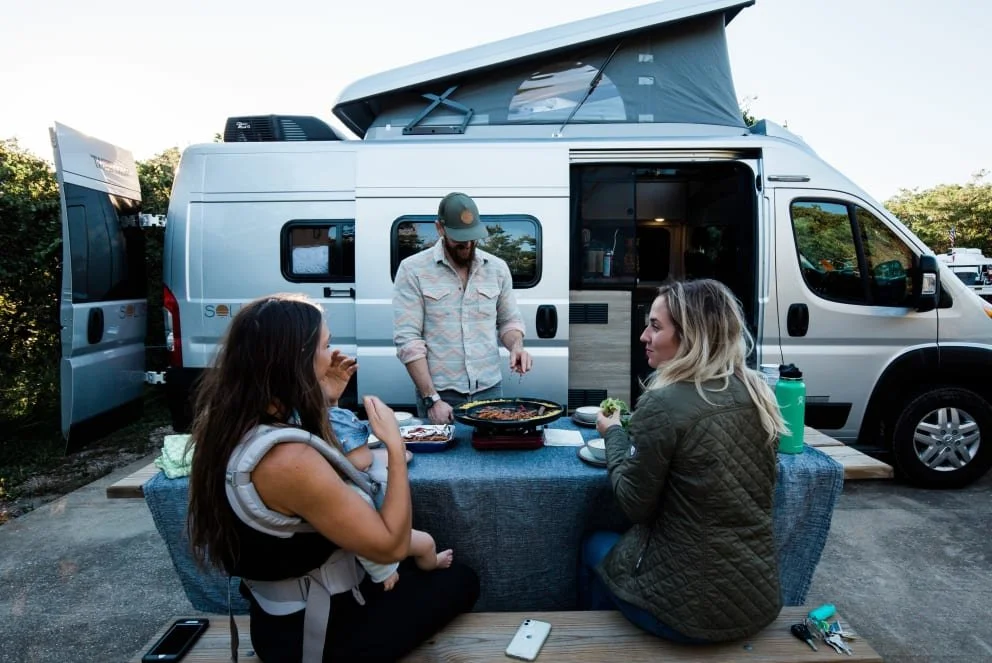
Most winter days here are simply good weather for being outside. A few places within easy reach of Lake City are worth a look.
The springs. North Central Florida's springs stay at 72 degrees year-round. In summer that feels cold. On a January morning, the water is often warmer than the air, and you can see steam rising off the spring runs. Ichetucknee Springs State Park in Fort White is under 40 minutes from I-75 Exit 427. It is open from 8 a.m. to sundown every day of the year, and entry is $6 per vehicle. Winter is the quiet season. It is a good time to paddle the river or walk out to the Blue Hole, and manatees sometimes come up the river in the colder months. Ginnie Springs near High Springs, about 40 minutes away, is another 72-degree option.
Olustee Battlefield. Olustee Battlefield Historic State Park, Florida's first state park, is about 15 miles east of Lake City on U.S. 90. Every February on Presidents' Day weekend the park hosts a large Civil War reenactment, and downtown Lake City holds the Olustee Festival that same weekend. In 2027 the reenactment is set for February 12–14. Expect that weekend to be busy in town and book early if your route takes you through.
Short days. In December and January the sun sets between about 5:30 and 6:15 p.m. If you're touring for the day or pulling in off the interstate, plan to be parked before dark.
Where North Central Florida fits in a winter trip
Heading south. Lake City is the first major junction inside Florida, where I-75 meets I-10, about 60 miles south of the Georgia line. Once you are here, the worst of the cold is behind you, and Orlando (about 150 miles) or Tampa (about 180 miles) is one easy leg the next morning. Our post on breaking the I-75 snowbird drive covers that route in more detail.
Heading north. In February and March, a night or two here before the Georgia run gives you time to watch the weather further up the road. It is easier to wait out a late snowstorm in the 60s than in a rest area in Tennessee.
Waiting out a front. If a strong front is coming through on travel day, an extra night is often the smart move. Towing a high-profile rig into 30-mph crosswinds behind a cold front is not worth the time you save. Stay put, let the wind lay down, and leave the next morning.
Winter at Sharrah's RV Park
Sharrah's RV Park is a 44-site transient park at I-75 Exit 427 in Lake City, at the I-75 / I-10 junction, with easy on and off the interstate. The sites are full-hookup pull-throughs, built for big rigs. You roll in, level up, and plug into water, sewer, and electric for the night. Every site has WiFi. Dogs are welcome. There is a security gate.
Booking is contactless, so you don't have to make it to a check-in desk before it closes on a short winter day. If a cold night catches you without a heated hose or other cold-weather gear, Camping World is right next door.
North Central Florida won't promise you a tropical winter. What it offers is mild days, dry weather, cold snaps that pass in a few days, and an easy place to stop in the middle of it all. You can see sites, rates, and availability at www.sharrahsrvpark.com.